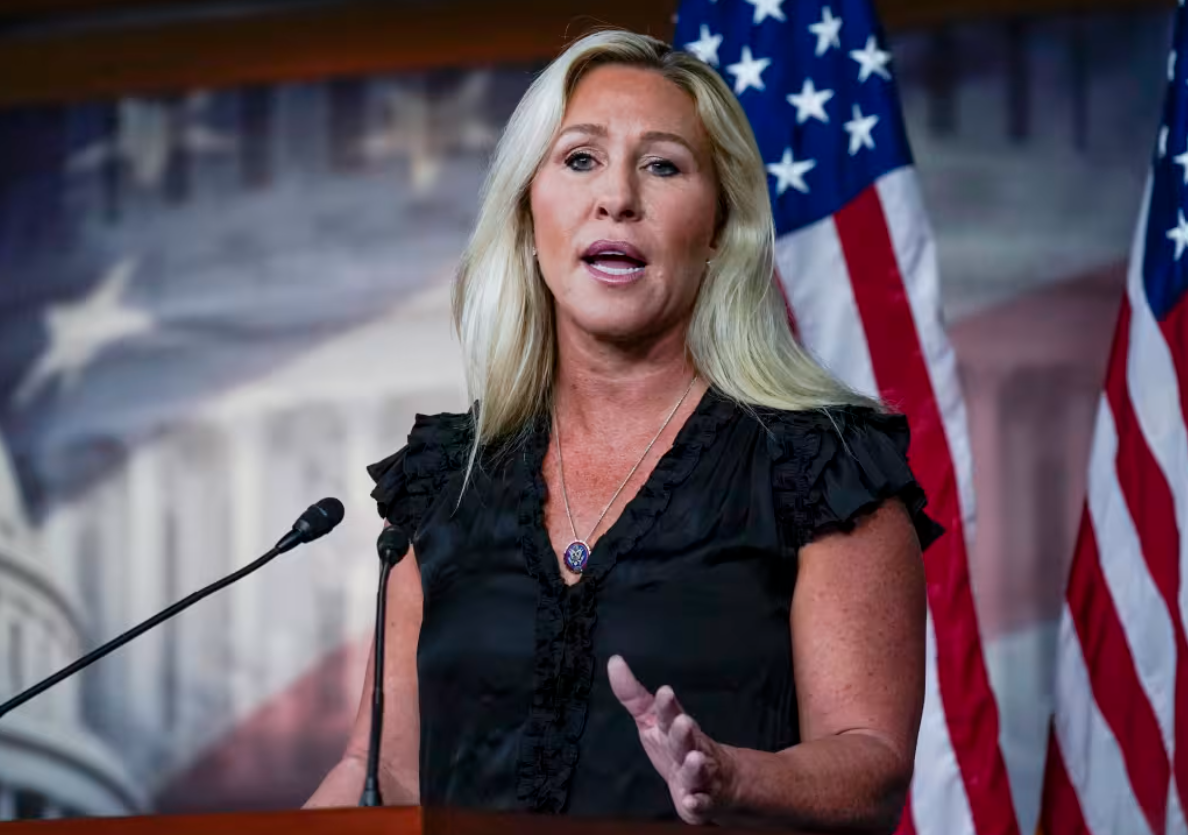

Rep. Marjorie Taylor Greene is pushing new legislation that would gradually dismantle the H-1B visa system, a move she says is aimed at protecting American workers but that further exposes divisions inside the Republican Party over immigration and labor policy.
A Growing GOP Rift
Greene’s proposal underscores an increasingly visible split among Republicans on how to handle employment-based immigration. The dispute centers around competing visions of U.S. economic strategy: one camp sees high-skilled visas as essential to innovation and national security, while another argues the system suppresses wages and sidelines American workers.
The bill also complicates the political landscape for President Donald Trump, who is trying to reconcile his administration’s push for stricter immigration controls with the needs of industries that rely heavily on foreign talent.
Background on H-1B
The H-1B program allows employers to bring in highly skilled foreign workers for specialized roles. Tech companies such as Amazon, Microsoft, and Google are among its most active users, often to fill positions requiring advanced engineering or computer science expertise. Roughly 400,000 H-1B approvals were issued in 2024, most of them renewals rather than new petitions.
Greene’s Proposal
Announcing the bill on X, Greene argued that the visa system has been exploited by major corporations and institutions to displace U.S. workers.
“I am introducing a bill to END the mass replacement of American workers by aggressively phasing out the H-1B program,” she wrote. “Americans are the most talented people in the world… I will ALWAYS put Americans first.”
Greene said her plan would eliminate the program entirely, with one temporary carve-out: up to 10,000 annual visas for medical professionals such as doctors and nurses. That exemption would be phased out over a decade.
Trump’s Position
Trump, however, has recently defended the need for skilled-worker visas. In a Fox News interview, he argued that some sectors—particularly advanced technology and defense manufacturing—lack sufficient domestic expertise.
“You don’t have certain talents,” he said. “You can’t take people off an unemployment line and say, ‘I’m gonna put you into a factory where we’re gonna make missiles.’ It doesn’t work that way.”
The administration has already tightened the program by imposing a new $100,000 annual fee for H-1B applicants and increasing oversight, steps that have prompted legal challenges from business groups and drawn mixed reactions within the GOP.
Reactions
Florida Gov. Ron DeSantis called the visa system “a scam” in a September post on X, arguing it drives down wages for U.S. workers—especially as AI is expected to reshape white-collar employment.
Immigration policy expert Aaron Reichlin-Melnick warned that additional costs could worsen staffing shortages in healthcare, noting that U.S. hospitals routinely rely on H-1B doctors to fill critical gaps.
Columbia University political scientist Robert Y. Shapiro told Newsweek that the issue, historically low-salience, has been elevated by Trump’s recent comments. He said political pressure could intensify if economic data later show layoffs among U.S. workers with skills similar to those of H-1B visa holders.
What’s Next
If formally introduced, Greene’s bill would join a series of congressional efforts aimed at reshaping or restricting the H-1B system. Any substantial overhaul could have far-reaching consequences for the U.S. labor market, technology sector, and America’s position in global competition for highly skilled talent.
